A Formation Number Is Not a Fixed Shape
A formation number describes a team’s starting arrangement; learn how roles shift in possession, defence and transitions to read the match more clearly.
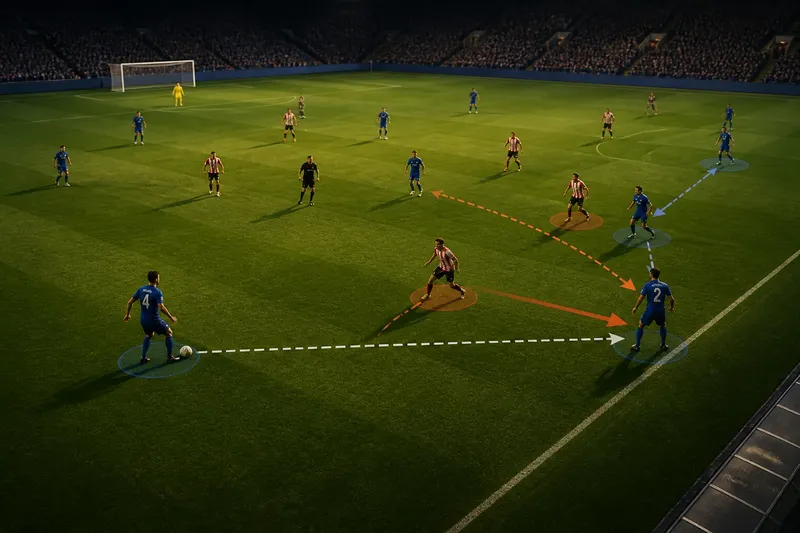
A formation number is a starting map, not a fixed set of positions. In a 4-3-3, for example, a midfielder may drop between the centre-backs during a build-up, while a full-back advances and a winger stays wide. To read the formation number, note what each movement makes possible and what space it leaves behind.
A formation number names the starting lines
Formation numbers usually count outfield players from the back towards the front. In a 4-3-3, the first four are defenders, the next three are midfielders and the last three are forwards; the goalkeeper is not included. A 4-2-3-1 describes four defenders, two deeper midfielders, three players ahead of them and one central striker.
The label gives viewers a rough map of the team sheet and its initial responsibilities. It does not specify every player’s exact position or decisions in each phase. Even before play begins, a wide forward might stand close to the touchline or nearer the striker, changing the team’s spacing without changing the formation label.
Possession reshapes the team around passing options
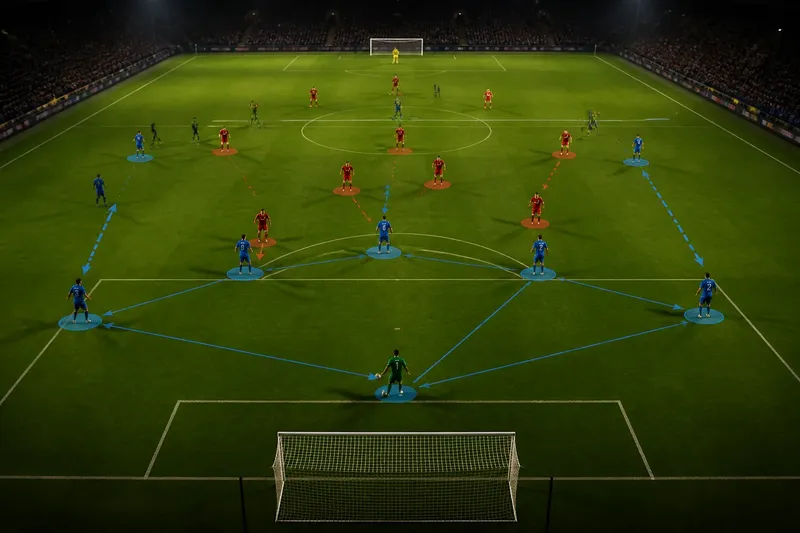
With the ball, players move to create routes forward and make space for one another. A centre-back may spread wide to receive, a full-back may advance as an outlet, and a central midfielder may drop towards the defenders. These movements form a build-up shape: the arrangement used to bring the ball out from the back.
Imagine a 4-3-3 side with the ball at its goalkeeper. The starting inputs are two centre-backs, a central midfielder, two full-backs and two wingers. The midfielder drops between the centre-backs, both full-backs move higher, and the wingers hold the width. The observable result is a three-player base near the goalkeeper and wider forward outlets; if the opposition blocks the central route, the goalkeeper can instead look towards a full-back or a winger. The starting label remains 4-3-3, but the arrangement has changed to support the next pass.
Near the opposition’s penalty area, a winger may move infield while an overlapping full-back takes the outside lane. The purpose is to give the attack both a closer option beside the striker and a route around the defence. To interpret the movement, check whether the full-back actually advances into that lane; if not, the winger may remain wide to preserve the team’s width.
An attacking shape describes players’ positions higher up the pitch, especially around the opposing defence. It can differ from the build-up shape because the team faces different spaces and opponents further forward.
Defending turns the same players into different lines
Without the ball, a team may retreat into a compact block. Its forwards drop closer to midfield, and midfielders narrow the gaps between themselves. A 4-3-3 can then resemble a 4-5-1, with the wide forwards alongside the central midfielders.
That appearance need not mean the coach has made a permanent change. It may be a response to the ball’s location or to an opponent moving into a dangerous area. If the opposition carries the ball towards one touchline, watch whether nearby players close that side while players on the far side move inwards. If the team shifts together, it is protecting space around the ball; if a far-side player stays wide, the team may be retaining cover against a switch of play.
Transitions interrupt settled shapes
A transition is the short period after possession changes hands. Players are reacting to the turnover rather than holding a settled attacking or defensive arrangement. A full-back who advanced to support an attack may need to recover, while a forward who wins the ball may run into open space.
To read a transition, identify who has just gained possession, then notice which players move towards the ball and which run away from it. If the team that lost the ball presses immediately, it may be trying to win possession back; if its players retreat, they may be organising a defensive block. Neither brief response alone establishes a new formation.
Repeated patterns matter more than a fresh label
Different commentators may name the same team’s shape differently because they are describing different moments: the team sheet, a defensive block or an attacking arrangement. Each label can make sense if the phase is clear. Two sides listed in a 4-2-3-1 may also use their wide attackers differently: one keeps them near the touchlines, while another brings them inside and relies on the full-backs for width.
It is not worth assigning a new formation number to every brief movement. A player stepping out to challenge or a midfielder moving across to receive does not automatically create a lasting shape. Look instead for repeated positions in settled possession, the team’s usual response after losing the ball and the spaces it regularly tries to occupy.
What questions help identify a changing shape?
Use the questions below to connect a player’s movement with the team’s repeated positions and the space those positions create.
How can I tell whether a formation has changed?
Look for a repeated arrangement during a settled phase, not one player’s brief movement. If the same players consistently occupy different defensive, midfield and forward lines, the team may be using a distinct shape in that phase.
Why does a full-back move into midfield?
A full-back may move inside to offer a central passing option or help the team retain possession in the middle. Check whether a team-mate advances into the space left on the flank; if nobody covers it, the opposition may have room to attack there.
Does a player’s listed position determine their role?
The listed position is a starting clue, but a role depends on the player’s tasks in different phases. A midfielder may drop towards the centre-backs during a build-up and move ahead of the ball to support an attack.
Why do formation graphics look different from the match?
Graphics simplify the starting arrangement so a line-up is easy to scan. They cannot show every adjustment prompted by the ball, the opposition or a change of phase.
Read the movement before naming the formation
Say a viewer sees a 4-3-3 and then notices the central midfielder dropping towards the centre-backs. The viewer notes that both full-backs are advancing and one winger is holding the touchline; next, they check whether an opponent follows the midfielder and whether a passing lane opens in front of the defence. If the lane opens, a teammate may receive there; if the opponent blocks it, the goalkeeper can use a wider outlet instead. The observed result helps explain the movement without treating one moment as a permanent formation change.
To read a formation number, note the starting arrangement, identify the phase of play, and track what a repeated movement creates or leaves exposed. The most useful clue may be the space a player vacates and whether a teammate moves to use or protect it.